

Executive summary
In April 2026, Pakistan's security landscape remained highly kinetic, with sustained militant activity concentrated in the border regions. TGD recorded 85 militant attacks during the month, while security forces conducted multiple intelligence-based operations (IBOs) that killed 109 militants. A further 82 militants were injured, including 2 who were later arrested.
The month's intensity was shaped by several high-impact developments: the vehicle-borne improvised explosive device (VBIED) attack in Bannu on April 2, continued pressure on law enforcement posts in southern Khyber Pakhtunkhwa, and the reported use of quadcopter drone strikes in Khyber District. Together, these incidents show that militant networks retained operational capacity despite counterterrorism pressure.
Report at a glance
| Metric | April 2026 |
|---|---|
| Militant attacks reported | 85 |
| Individuals affected by militant violence | 161 |
| Fatalities | 67 |
| Injuries | 94 |
| Militants killed in counterterrorism operations | 109 |
| Militants injured in counterterrorism operations | 82 |
| Militants later arrested | 2 |
| Most affected areas | Khyber Pakhtunkhwa and Balochistan |
Operational overview
The transition from March to April 2026 marked a shift from high-frequency, lower-intensity activity toward more lethal and visible strikes. The geographical center of gravity remained in the southern districts of Khyber Pakhtunkhwa, especially Bannu, Lakki Marwat, Tank, North Waziristan, and South Waziristan.
In Khyber Pakhtunkhwa, the conflict environment was characterized by suicide missions, attacks on fixed posts, and the use of stand-off tactics. In Balochistan, militant activity remained focused on transport corridors, checkpoints, urban centers, and logistics routes. The Sorab, Mastung, Gwadar, and Quetta areas remained important nodes in that pattern.
Police and security forces faced repeated pressure. Reported incidents included an exchange of fire at the NADRA office in Bannu, the attack on the Kangar Pul police post that killed Police Official Sher Muhammad Khan, and a three-sided assault on the Mazanga police post. Militants also targeted polio vaccination security teams and mobile police patrols, including an IED strike that injured five officers.
Militant actors also continued targeting state-linked infrastructure and public services. The demolition of a Government Boys Primary School and a Government Girls High School pointed to an effort to undermine local governance and discourage civilian participation in development activity.
Quantitative analysis: casualties
During April 2026, 161 individuals were affected by militant violence across Pakistan. This included 67 fatalities and 94 injuries. Civilians were the most affected category, with 35 fatalities and 45 injuries, followed by law enforcement agencies with 21 fatalities and 42 injuries.
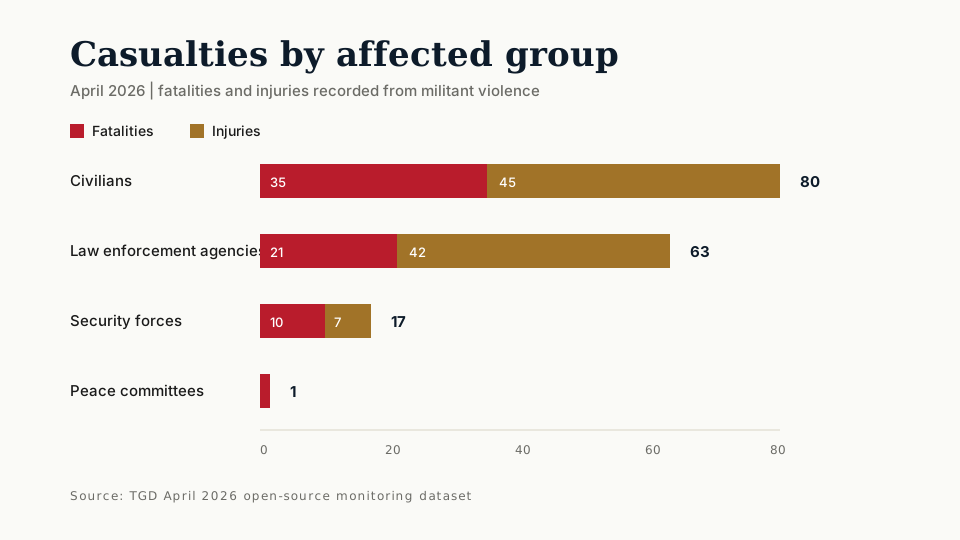
| Affected group | Fatalities | Injuries | Total casualties |
|---|---|---|---|
| Civilians | 35 | 45 | 80 |
| Law enforcement agencies | 21 | 42 | 63 |
| Security forces | 10 | 7 | 17 |
| Peace committees | 1 | 0 | 1 |
| Total | 67 | 94 | 161 |
Counterterrorism and IBO activity during April 2026 killed at least 109 militants across multiple operational theaters. This included 37 militants killed during phases of Operation Ghazab-ul-Haq, 22 militants killed in a joint IBO in Bara, Khyber District, and 50 others killed during border clearance and targeted counterterrorism operations.
Threat actors
Militant violence in April 2026 was dominated by several major insurgent and terrorist actors operating across distinct regional theaters.
In Khyber Pakhtunkhwa, Tehreek-e-Taliban Pakistan (TTP) and the Hafiz Gul Bahadur (HGB) group were primarily responsible for activity in the newly merged districts and the southern belt. North Waziristan, South Waziristan, Bannu, Lakki Marwat, Tank, and Dera Ismail Khan remained the principal centers of violence.
In Balochistan, Baloch nationalist militant groups, especially the Balochistan Liberation Army (BLA/Jayand faction) and the Balochistan Liberation Front (BLF), directed violence through coordinated assaults, ambushes, and attacks targeting transport infrastructure. The BLA attack on a Coast Guards patrol boat off Jiwani marked a significant escalation into Pakistan's maritime domain.
The Islamic State - Khorasan Province (ISKP) expanded its operational footprint in Bajaur District through targeted assassinations and IED attacks against individuals accused of cooperating with the state, local security personnel, and religious figures. Ittehadul Mujahideen Pakistan (IMP) remained notable for the reported use of quadcopter drone strikes, indicating a gradual tactical evolution.
The April record also includes multiple attacks by unidentified armed individuals and motorcycle-borne assailants. Many of these incidents remained unclaimed and are assessed as likely proxy or splinter-cell activity intended to preserve plausible deniability around targeted killings of political, tribal, and religious figures.
Provincial security assessment
Khyber Pakhtunkhwa
Khyber Pakhtunkhwa remained the main theater of militant violence in April 2026. Activity was concentrated in strategically significant border districts where the state's administrative reach continues to face persistent pressure.
The report separately recorded 87 Khyber Pakhtunkhwa entries when militant incidents and security-force or police intelligence operations are counted together. Bannu recorded the highest number, followed by Bajaur and Lakki Marwat.
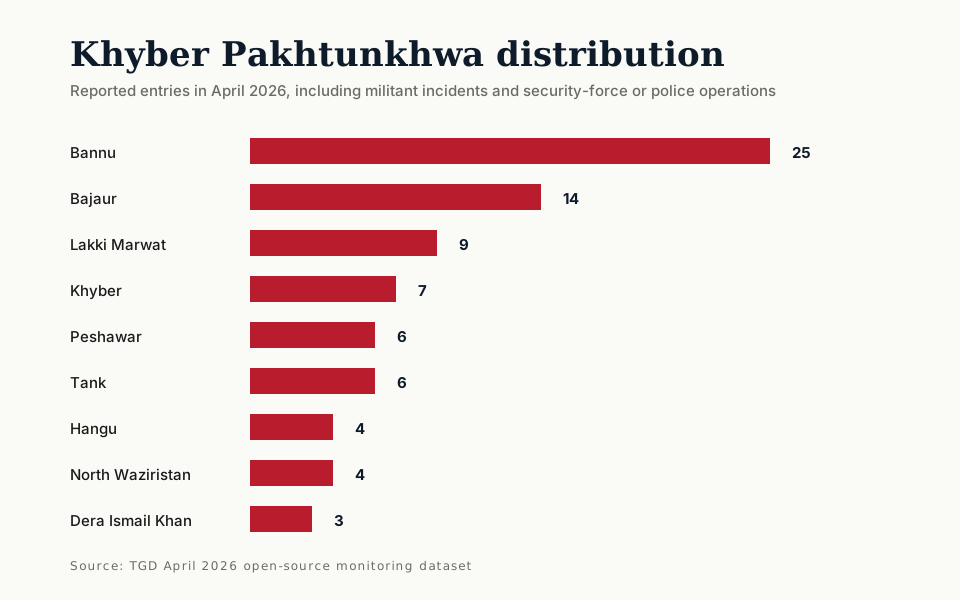
| District | Reported entries |
|---|---|
| Bannu | 25 |
| Bajaur | 14 |
| Lakki Marwat | 9 |
| Khyber | 7 |
| Peshawar | 6 |
| Tank | 6 |
| Hangu | 4 |
| North Waziristan | 4 |
| Dera Ismail Khan | 3 |
| South Waziristan | 2 |
| Mohmand | 2 |
| Swat, Kohat, Kurram, Charsadda, Mardan | 1 each |
Security forces reported multiple operational successes during the month, including the killing of TTP commander Hussain Ullah, also known as Khalid, and militant figure Faridullah Toofan. Even so, the continued assassinations of political and religious figures, including Mohammad Roshan of Jamaat-e-Islami and Maulana Khalid Amin, show that militant networks retained the ability to conduct localized assassination campaigns.
Balochistan
Activity in Balochistan remained concentrated along transit corridors, urban centers, and security checkpoints. Thirteen militant incidents were recorded across the province. Quetta was the most affected district, with 4 incidents, followed by Chagai with 2. One incident each was reported in Kachhi, Noshki, Khuzdar, Kalat, Barkhan, Gwadar, Mastung, and Sorab.
Security forces conducted approximately four IBOs in the province, disrupting militant activity and killing several militants. A notable operational success was the interdiction of a militant roadblock on the N-85 highway near Sorab on April 6, which helped secure a critical logistics route.
The most significant development was the April 12 BLA attack on a Pakistan Coast Guards patrol boat off the coast of Jiwani. The attack, alongside the announcement of the BLA's so-called "Hammal Maritime Defense Force," suggests an effort to extend the group's operational theater toward coastal and maritime environments around Gwadar and Pakistan's western coastline.
Gilgit-Baltistan
Gilgit-Baltistan remained relatively calm, with one militant incident reported in April 2026. On April 13, gunmen opened fire on a police team conducting an anti-narcotics operation in Thor Nala, Chilas, killing three police personnel and injuring four others. The attack was claimed by the TTP.
When viewed alongside the previous month's incident reportedly linked to IMP, the Chilas attack may indicate a gradual shift of militant attention toward the strategically sensitive Gilgit-Baltistan region. Even so, the wider regional security situation remained comparatively stable during the reporting period.
Punjab and Sindh
In Sindh, one incident was reported in Karachi's Manghopir area, involving clashes between police personnel and armed motorcyclists affiliated with the TTP. The incident killed one police officer. No militant incidents were reported in Punjab during the period.
Both provinces maintained a comparatively stable posture. Security activity was largely limited to preventative IBOs and interdiction of potential spillover cells rather than active insurgent combat.
Tactics
Direct fire and armed assaults remained the most frequently observed tactic in April 2026, accounting for 45 recorded incidents. Targeted killings were the second most common tactic, followed by IED and explosive attacks.
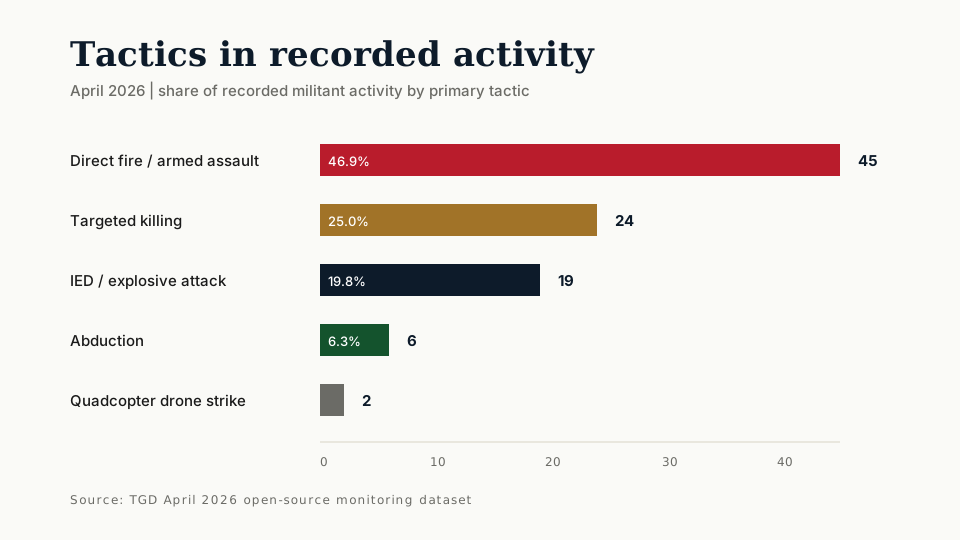
| Tactic | Recorded incidents | Share |
|---|---|---|
| Direct fire and armed assault | 45 | 46.9% |
| Targeted killing | 24 | 25.0% |
| IED or explosive attack | 19 | 19.8% |
| Abduction | 6 | 6.3% |
| Quadcopter drone strike | 2 | 2.1% |
The tactical picture shows a diversified militant approach. Armed assaults and targeted killings remained dominant, while IED use continued to pressure police, security forces, and state-linked infrastructure. Abductions continued to serve as a coercive tool in conflict-prone districts, while low-cost quadcopter drone strikes pointed to experimentation with aerial capabilities.
Key takeaways
- Technological adaptation: The continued use of quadcopter drones by militant groups, especially IMP, highlights a growing challenge to conventional static defenses used by police and paramilitary forces in southern and merged districts of Khyber Pakhtunkhwa.
- Expansion of maritime militancy: The BLA attack near Jiwani and the announcement of the so-called Hammal Maritime Defense Force signal an alarming effort to move militant activity into Pakistan's maritime and coastal security environment.
- Targeting of transit and logistics corridors: Roadblocks and attacks along routes such as the N-85 corridor in Balochistan show a strategic focus on disrupting economic connectivity, restricting state mobility, and undermining logistics routes.
- Persistent threat in southern KP: North Waziristan, South Waziristan, Bannu, Lakki Marwat, Tank, and Dera Ismail Khan remained principal centers of violence, reflecting sustained TTP and affiliate capacity.
- Attention toward Gilgit-Baltistan: The Thor Nala attack in Chilas, when viewed with the previous month's incident reportedly linked to IMP, suggests possible militant attention toward a region that has traditionally remained comparatively insulated from sustained militant violence.
Editorial note
This report is based on open-source data and daily monitoring of the security situation. Every effort has been made to ensure accuracy, but information may be revised as new reporting becomes available.
Compiled by Muhammad Sameer Gulzar and Sayeda Farani Fatima. Edited by Aamir Hayat and Mudassir Khattak.
Original PDF
The full report is now available above as a scrollable web article. A copy of the original PDF remains available for download: